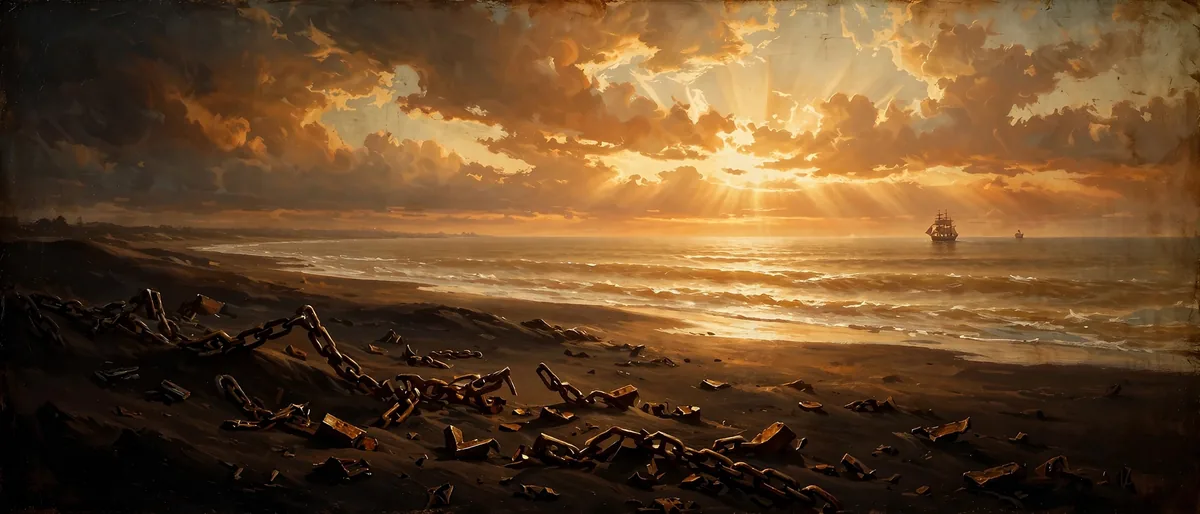
Deuteronomy 28 and the Slave Trade: The Evidence
Twelve and a half million. That is the documented number of Africans embarked onto European and American slave ships between 1501 and 1867 — the largest forced migration in recorded history, reconstructed voyage by voyage from ship logs, port records, and bills of sale in the SlaveVoyages database built by historians David Eltis and David Richardson.
Of those 12.5 million, about 10.7 million survived to be sold in the Americas. About 1.8 million — more than 14 percent — died on the crossing.
Centuries before the first caravel left Lisbon, an ancient text described exactly this: a covenant people put on ships, sold as bondmen and bondwomen, scattered among the nations, stripped of everything. Deuteronomy 28.
This post lays out the documented record — the numbers, the nations, the mechanics — and then reads the prophecy beside it, verse by verse.
The Numbers: What the Records Say
The SlaveVoyages database holds records of some 35,000–36,000 individual slaving voyages — an estimated 80 percent of all of them — and the totals are the scholarly baseline:
- 12.5 million embarked in Africa; 10.7 million disembarked in the Americas; 1.8 million dead at sea
- More than 80 percent crossed after 1700; the peak decades (1780s–1800s) saw 80,000+ shipped per year
- Before 1820, four enslaved Africans crossed the Atlantic for every one European
The 1.8 million counts only the ocean crossing. It does not count those killed in raids, dead on the forced marches to the coast, or dead in the fort dungeons awaiting ships.
Who Ran It
The carrier flags, from the same database:
- Portuguese: 5.85 million — nearly half the entire trade
- American: 305,000; Danish: 111,000
This was state-backed commerce: the Portuguese crown and its traders, Britain's Royal African Company (chartered 1672), the Dutch West India Company (1621), French chartered companies, Spain's asiento licensing system. Liverpool alone carried some 1.2 to 1.5 million Africans — half the British trade, a tenth of the whole traffic. In the trade's final decade the city accounted for roughly 40 percent of all European slaving voyages.
The engine was the plantation system — the slave-worked sugar plantation perfected by the Portuguese on Madeira and São Tomé in the 1400s, exported to Brazil around 1560 and to the Caribbean from the 1640s. When the indigenous Caribbean population collapsed — the Taíno of Hispaniola falling from hundreds of thousands to under 10,000 within decades — the planters replaced them with African labor through a supply network that already existed.
Who Was Taken, and From Where
The largest single source was West-Central Africa (Congo/Angola): 39.4 percent of arrivals between 1650 and 1900. Then the Bight of Benin (20.2%), the Bight of Biafra (14.6%), the Gold Coast (10.4%), Senegambia, Upper Guinea, the Windward Coast, and southeastern Africa.
The peoples have names: Kongo, Mbundu, Yoruba, Fon, Igbo, Akan, Mandinka, Wolof, Fulani — among others. They were taken through warfare, raiding and kidnapping, and judicial enslavement. And the record is unambiguous that African kingdoms were sellers: Dahomey's King Agaja conquered neighboring kingdoms specifically to control trade routes; Asante and Oyo traded captives for European firearms. The Europeans rarely captured people inland themselves — they bought them at coastal forts like Elmina (1482), Gorée, and Cape Coast Castle.
Where They Were Taken
- Brazil: 4.86 million — 46 percent of the entire trade. Rio de Janeiro alone received some 2 million.
- British Caribbean: 2.32 million (Jamaica over 1 million; Barbados 493,000)
- French Caribbean: 1.12 million (Saint-Domingue — Haiti — 773,000)
- Spanish Americas: ~1.06 million (Cuba 778,000)
- Dutch Americas: 445,000 (Suriname)
- Mainland North America: 389,000 — just 3.6 percent of the total
The labor: sugar in Brazil and the Caribbean, gold and diamond mining in Minas Gerais, tobacco in the Chesapeake, rice in Carolina — where planters specifically sought Senegambians for their rice-growing expertise — and coffee in 19th-century Brazil.
On the sugar plantations of Barbados, Jamaica, Saint-Domingue, and Brazil, the enslaved could not reproduce themselves — deaths exceeded births every year, so the system depended on constant new imports. Mainland North America was the exception: the only slave society in the Americas whose enslaved population grew by natural increase.
Who Was Involved — The Honest Accounting
The primary engine is not in dispute: European crowns, chartered companies, and private merchants financed, organized, and carried the overwhelming bulk of 12.5 million people. African kingdoms and middlemen were the documented sellers on the coast.
And the record on Sephardic Jewish involvement is specific: in the Dutch Atlantic — Recife, Curaçao, Suriname, Barbados — Sephardic merchants traded enslaved people, financed voyages, and owned plantations (Suriname's Jodensavanne held some 40 Jewish-owned plantations). The historians who quantified it — Eli Faber's book-length study of the British empire, Seymour Drescher's work on the Dutch trade — found it real and locally visible, but a tiny fraction of one percent of the whole. No Jewish chartered slaving company ever existed. Claims of Jewish primacy in the trade have been rejected across the historical profession, including a unanimous 1995 statement by the American Historical Association.
Why does this accounting matter? Because the truth does not need inflation. The documented record is devastating enough on its own — and a case built on inflated numbers collapses the moment it is checked, taking the real evidence down with it.
The Prophecy: Deuteronomy 28, Verse by Verse
Now read the ancient text beside the record:
"The LORD shall bring thee into Egypt again with ships, by the way whereof I spake unto thee, Thou shalt see it no more again" (Deuteronomy 28:68). A people transported by ship into bondage, never to see their homeland again. ("Egypt" is Scripture's own figure for bondage — see Revelation 11:8.)
"And there ye shall be sold unto your enemies for bondmen and bondwomen, and no man shall buy you" (28:68). Sold — not hired. Bondmen and bondwomen — the exact legal condition of chattel slavery, human beings as property.
"The LORD shall scatter thee among all people, from the one end of the earth even unto the other" (28:64). Brazil. Jamaica. Saint-Domingue. Cuba. Barbados. Carolina. A scattering across continents — "removed into all the kingdoms of the earth" (28:25).
"Thy sons and thy daughters shall be given unto another people, and thine eyes shall look, and fail with longing for them all the day long" (28:32). The auction block's family separation — routine, systematic, as policy.
"The stranger that is within thee shall get up above thee very high; and thou shalt come down very low" (28:43). The complete inversion — from a people to property.
"Thou shalt become an astonishment, a proverb, and a byword, among all nations whither the LORD shall lead thee" (28:37).
Note what the text does not do: it does not name the nations holding the whip. The prophecy describes the condition of the afflicted — ships, sale, scattering, the stripping of everything. That match stands on the victims' side regardless of who the carriers were.
What This Means for the Remnant Today
- Know the numbers. 12.5 million embarked, 10.7 million landed, 1.8 million dead at sea — these are not estimates from advocacy; they are the voyage records. The truth is documented. Learn it cold.
- Keep the proportions honest. The European colonial machine was the engine; African kingdoms sold; Sephardic merchants participated in the Dutch sector in measurable but small share. Inflating any party's role hands critics a free debunking. The real record needs no help.
- Read the prophecy as written. Deuteronomy 28 describes the condition — ships, bondage, scattering, family separation. Argue from what the text says, not from what it doesn't. The match on the victims' side is the unshakeable ground.
- Remember the end of the story. The trade did not fade; it was suppressed — and Haiti proved the enslaved could break it themselves (1791–1804), the only successful large-scale slave revolution in history. Bondage ends. That, too, is in the Book.
The record is written in ship logs. The prophecy was written centuries earlier. Read them together, and decide for yourself who the people of the Book are.
FAQ
Q: Where do the 12.5 million / 10.7 million figures come from? A: The Trans-Atlantic Slave Trade Database (SlaveVoyages), built by historians David Eltis, David Richardson, and colleagues from some 35,000–36,000 documented voyages — ship logs, port records, and sale documents — with statistical corrections for undocumented voyages. It is the scholarly baseline, summarized in Eltis & Richardson's Atlas of the Transatlantic Slave Trade (Yale, 2010).
Q: Did African kingdoms participate in selling captives? A: Yes — this is unambiguous in the record. Dahomey, Asante, Oyo, and others sold war captives and kidnapped people to European buyers at the coastal forts, trading them for firearms and goods. The Kingdom of Kongo is the documented counter-case: it forbade enslaving its own citizens and repatriated those illegally taken.
Q: What was the Jewish role in the slave trade? A: Documented and specific: Sephardic merchants in the Dutch Atlantic (Recife, Curaçao, Suriname, Barbados) traded enslaved people and owned plantations. The quantitative historians (Faber, Drescher) found this real but small — a tiny fraction of one percent of the 12.5 million total. Claims of Jewish primacy have been rejected by the historical profession, including a unanimous 1995 American Historical Association statement.
Q: Does Deuteronomy 28 name who would enslave Israel? A: No. The chapter describes the condition of the afflicted — ships (v. 68), sale as bondmen and bondwomen (v. 68), scattering among the nations (v. 64), children given to another people (v. 32). The prophecy's force is in that match, not in naming the carriers.