The fourth letter of the Hebrew alphabet is a door.
Not a letter that sounds like a door. Not a letter that symbolizes a door as an afterthought. The ancient pictograph of Dalet (ד) is a tent door — a curtain hanging from a pole across the entrance of the tent. Its ancient name, Dal, meant door. In modern Hebrew, the word is still delet — door.
And when you understand the door, a dozen passages of Scripture suddenly snap into focus. YAHUSHA's words, the Passover, the knocking at the door in Revelation — they were all pointing at Dalet the whole time.
The Letter That Is a Door
Let's get the facts straight.
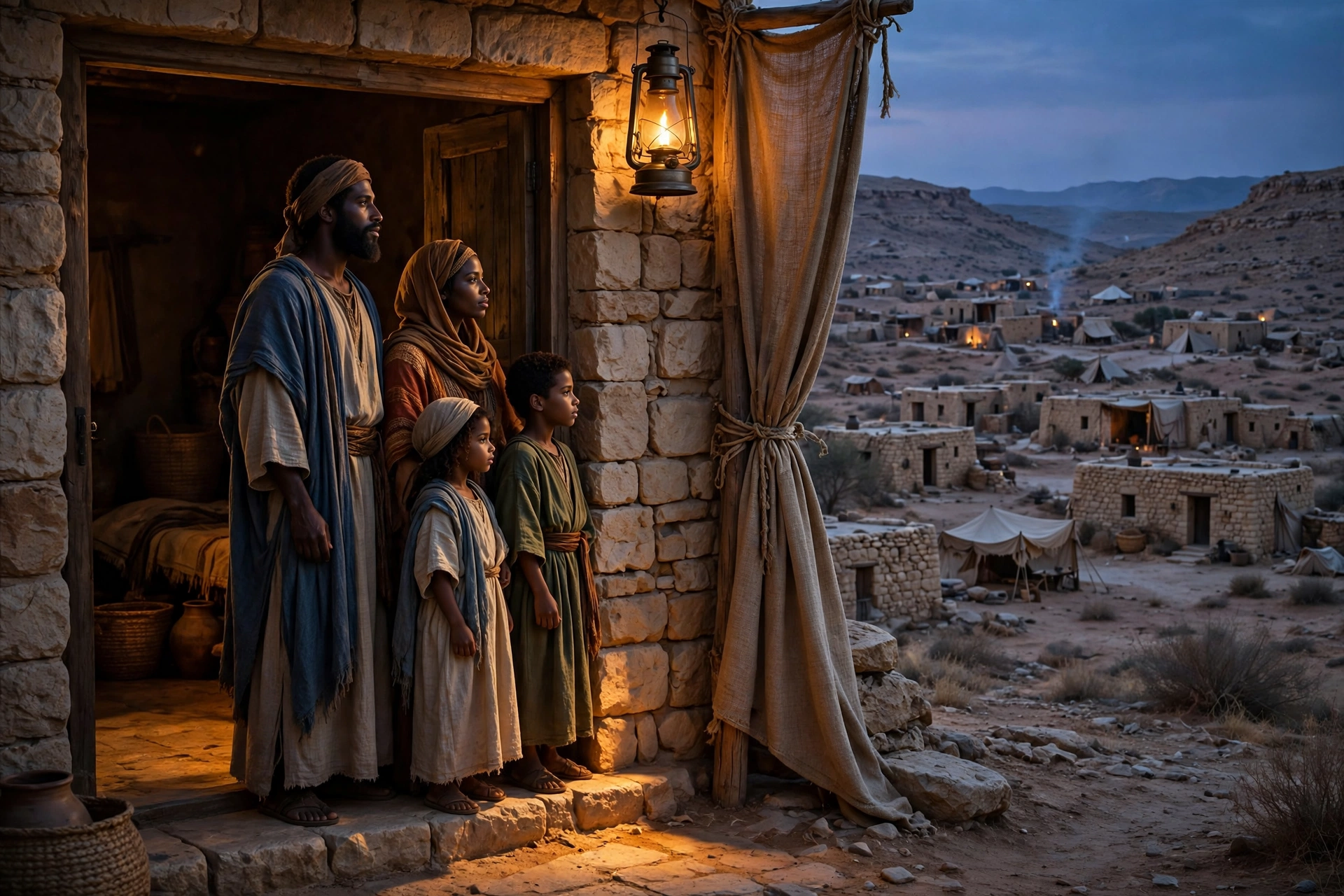
Dalet is the fourth letter of the Hebrew alphabet. Its numerical value is four. In the earliest paleo-Hebrew script, it was drawn as a tent door: the entrance of a tent covered by a hanging curtain suspended from a horizontal pole. You didn't turn a knob. You lifted the curtain, stepped through, and let it fall behind you.
Look at the letter's shape even today: a vertical line crowned by a horizontal one. A doorpost and a lintel. Hebrew scribes have always been careful to keep the Dalet distinct from the Resh — because a door is not a head, and an entrance is not a beginning. They are different things entirely.
That matters. Because Scripture treats the door as its own subject, over and over again.
A Door Has Exactly One Job
A door does not decorate. A door does not explain. A door does one thing: it decides who is in and who is out.
Every door in Scripture carries that same weight. The door of the ark — shut by YAHUAH Himself, and once shut, no one opened it. The door of the tent where Abraham sat when YAHUAH appeared to him (Genesis 18:1). The blood on the doorposts in Egypt. The knock at the door in Revelation.
The question Scripture keeps asking is the same one Dalet asks: are you through the door, or are you still outside?
The Blood on the Door
On the night of the Passover, YAHUAH gave Israel an instruction that makes no sense until you understand Dalet:
"And they shall take of the blood, and strike it on the two side posts and on the upper door post of the houses, wherein they shall eat it." (Exodus 12:7)
The blood went on the door. Not the roof. Not the window. The door.
They took hyssop and struck the lintel and the two side posts (Exodus 12:22), and YAHUAH said He would pass over every door marked by the blood — "and will not suffer the destroyer to come in unto your houses to smite you" (Exodus 12:23).
Think about what that means. The destroyer came to Egypt, but the blood on the door was the line. Inside the door, under the blood: life. Outside the door: judgment. The door was the boundary of salvation, and the blood was what made the boundary hold.
Israel was commanded to write the words of YAHUAH on the doorposts of their houses (Deuteronomy 6:9). The Word belongs on the door — because the door is where the decision happens.
"I Am the Door"
Centuries later, YAHUSHA stood before the people and said something that would have landed with full force on any Israelite who knew their letters:
"I am the door of the sheep." (John 10:7)
Then He said it again, so no one could miss it:
"I am the door: by me if any man enter in, he shall be saved, and shall go in and out, and find pasture." (John 10:9)
He didn't say He was a door. He said He was the door. One door. One entry. And through that entry: salvation, freedom ("go in and out"), and provision ("find pasture").
In the ancient sheepfold, the shepherd himself slept across the doorway at night. The sheep entered through his body. Nothing got in without passing the shepherd, and the sheep went out each morning the same way. YAHUSHA wasn't reaching for a poetic image — He was describing exactly how a sheepfold worked, and exactly how the Kingdom works.
There is no side entrance. There is no climbing over the wall. The shepherd is the door, or there is no entry at all.
The Same Word Means "Poor"
Here is where Dalet gets even sharper.
The root behind Dalet — dal (H1800) — also means poor, weak, lowly. David cried out, "Incline your ear, O YAHUAH, and answer me, for I am poor and needy" (Psalm 86:1). The same word. The door and the poor share a name.
Why? Because you do not strut through a tent door. A tent door hangs low. You stoop. You bow your head to enter.
The door of the Kingdom is built the same way. "Blessed are the poor in spirit: for theirs is the kingdom of heaven" (Matthew 5:3). The poor in spirit — the lowly, the ones who know they bring nothing — they enter. The proud stand outside, too tall for the doorway, unwilling to bend.
Dalet carries both truths at once: the door is open, but you enter on your knees.
The Door Is Still Standing
The door didn't close when the sun rose over Egypt. It is still there.
"Behold, I stand at the door, and knock: if any man hear my voice, and open the door, I will come in to him, and will sup with him, and he with me." (Revelation 3:20)
Read that carefully. YAHUSHA is outside the door, knocking. The door has no handle on His side. The opening is your move. He does not kick it down. He knocks — and waits for the sound of a hand turning the latch from within.
"Ask, and it shall be given you; seek, and ye shall find; knock, and it shall be opened unto you." (Matthew 7:7)
And to those who overcome, He holds "the key of David" — He who opens and no one shuts, and shuts and no one opens (Revelation 3:7). The door He opens for the remnant cannot be closed by any power on earth.
"Strive to enter in at the strait gate: for many, I say unto you, will seek to enter in, and shall not be able." (Luke 13:24)
Many will seek. Not all will enter. The door is narrow, and Dalet has been telling us the terms all along: come low, come under the blood, come through the one door.
What This Means for the Remnant Today
So what do you do with a letter that is a door?
- Stop looking for another entrance. No amount of religion, tradition, or sincerity is a second door. YAHUSHA is the door. Enter through Him or don't enter at all.
- Come low. The tent door demands a bowed head. Confession, repentance, and humility are not the price of entry — they are the shape of the doorway. You cannot enter standing tall.
- Get under the blood. The Passover door only saved the house it marked. Being near the door wasn't enough. The blood had to be on it. The remnant is not the crowd that admires the door — it's the household marked by the blood.
- Answer the knock. YAHUSHA is knocking now, today, on your door. Don't admire the knocking. Open it. He comes in with a meal — fellowship, covenant, restoration — for everyone who opens.
- Guard your door. "Sin lieth at the door" (Genesis 4:7). Doors work both ways. Keep the entry of your heart under the same blood that saved your house.
Dalet is the fourth letter. It has been standing there since the beginning, drawn as a tent door, whispering the same message: there is a way in, and it is through the door.
The only question is whether you'll walk through it.
Frequently Asked Questions
What is the Hebrew letter Dalet? Dalet (ד) is the fourth letter of the Hebrew alphabet with a numerical value of four. In ancient paleo-Hebrew, it was drawn as a tent door, and its ancient name Dal meant door. The modern Hebrew word for door is still delet.
What did YAHUSHA mean when He said "I am the door"? In John 10:7 and John 10:9, YAHUSHA declared Himself the one and only entry into the Kingdom. In an ancient sheepfold, the shepherd slept across the doorway — the sheep entered through him. YAHUSHA was saying there is no other entrance: enter through Him and you are saved.
Why was there blood on the door during Passover? YAHUAH commanded Israel to strike the blood of the lamb on the lintel and doorposts (Exodus 12:7, 22). The blood marked the boundary: every house under the blood was passed over by the destroyer (Exodus 12:23). The door was the line between judgment and life.
What does Dalet teach about humility? The Hebrew root dal (H1800) means poor, weak, and lowly — the same root as the door. A tent door hangs low; you stoop to enter. Scripture says the poor in spirit inherit the Kingdom (Matthew 5:3, Psalm 86:1). Entry requires bowing.