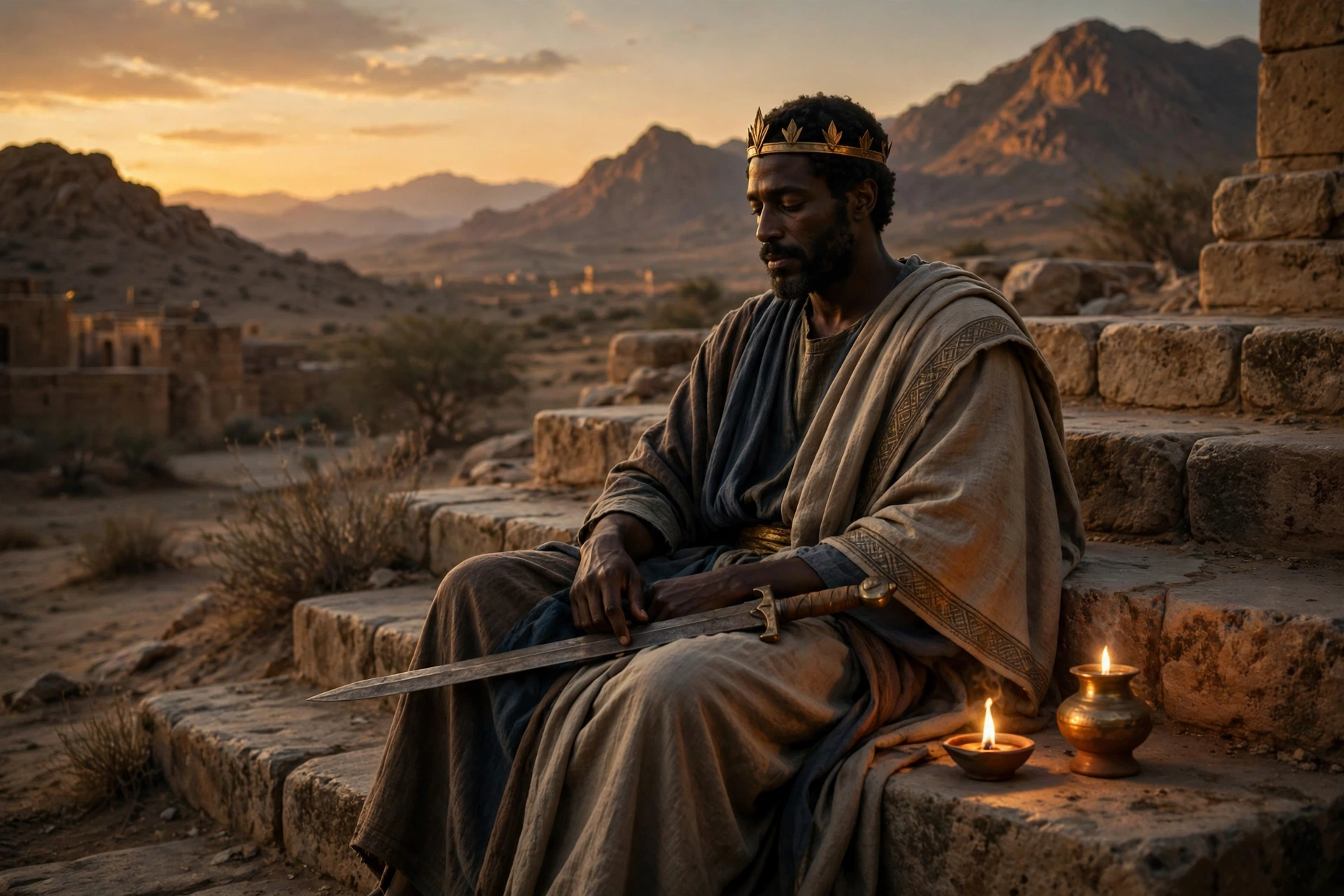
One Hebrew letter means both a sword and a meal. That is not a contradiction. That is the message.
Zayin (ז) is the seventh letter of the Hebrew aleph-bet. Its ancient pictograph is a weapon — a sword, a cutting blade. Yet the same root gives us the word for nourishment. In a single letter, Scripture hands us a paradox the remnant needs today: the thing that cuts is the thing that feeds.
Zayin at a Glance
- Position: seventh letter of the aleph-bet
- Sound: "z," as in "zebra"
- Ancient pictograph: a weapon — a sword or cutting tool
- Core meanings: weapon, sword, crown, sustain, nourish, cut, separate
Seven is the number of completion in Scripture. YAHUAH finished the work of creation in six days and rested on the seventh (Genesis 2:2-3). The seventh day, the Shabbat, is set apart. So before zayin ever means a weapon, it already means this: what YAHUAH finishes, He seals. Completion is not an accident. It is a crown.
A Sword That Cuts — and a Plow That Feeds
Here is where zayin gets strange, and where it gets good.
The word zayin means "weapon" or "sword." The phrase k'lei zayin means "weapons" or "instruments of war." In modern Hebrew, lezayen means "to arm." The pictograph backs it up: a blade, made to cut.
But the same letters sit at the root of zan (זַן) — to nourish, to sustain. The word mazon (מזון) means food, sustenance. The blessing after meals thanks the One who feeds all. The sword and the supper share a root.
How can one letter hold both? Because in the ancient world, the plow and the sword were the same shape doing the same work: cutting. A plow cuts the earth open so seed can go in. A sword cuts through what stands in the way. Both divide. Both make room for life.
The lesson is plain: what cuts you free is what feeds you. The Word does not only comfort. It separates — truth from tradition, covenant from compromise, the remnant from the crowd. And that separation is nourishment, not punishment.
The Crowned Vav
Look at the shape of the letter itself. Zayin is built like a vav — the sixth letter, the nail, the connector between heaven and earth — with a crown on its head.
Last week we saw vav as the hook that joins. Zayin is that same connector, crowned. The connection is not left bare; it is honored. A crowned connection is authority. It is a man joined to YAHUAH, standing upright, carrying weight he did not earn on his own.
This is why teachers call zayin the "crowned vav." The nail becomes a scepter. The connector becomes a king. And the picture points straight at YAHUSHA — the Man who is the connection between YAHUAH and His people, crowned, carrying the sword of the Spirit.
Seven: Completion and Rest
Zayin's number is seven, and seven keeps showing up wherever YAHUAH finishes something:
- Seven days of creation, ending in Shabbat rest (Genesis 2:2-3)
- The seventh day commanded as set-apart rest (Exodus 20:8-11)
- Seven feasts appointed in Leviticus 23, marking YAHUAH's calendar from Passover to Tabernacles
- Seven assemblies addressed in Revelation 2-3
Seven does not mean "almost done." It means done, sealed, complete. The sword of zayin cuts away what is unfinished business — the striving, the half-obedience, the mixture — so that rest can actually arrive. You cannot rest while you are still fighting the wrong war. Zayin ends the war that matters so the rest can begin.
Zayin in Psalm 119
Psalm 119 is built on the aleph-bet: 22 sections, one per letter, eight verses each. The zayin section, Psalm 119:49-56, opens with a word that starts with zayin itself: zakor — "remember."
"Remember the word to Your servant, upon which You have caused me to hope" (Psalm 119:49).
The psalmist does not ask YAHUAH to remember because YAHUAH forgets. He anchors himself in what was spoken. His comfort in affliction is the Word (Psalm 119:50). The proud may mock him, but he does not turn from the Torah (Psalm 119:51). At night he remembers the Name (Psalm 119:55).
That is zayin in action: memory as a weapon. When affliction comes, the remnant does not fight with new ideas. It fights with what was already spoken. Remembering is not nostalgia. It is warfare.
The Sword of the Spirit
The New Testament picks up the same blade and names it plainly.
"Take the sword of the Spirit, which is the word of YAHUAH" (Ephesians 6:17).
"For the word of YAHUAH is living and powerful, and sharper than any two-edged sword, piercing even to the division of soul and spirit" (Hebrews 4:12).
Notice what the sword divides: soul from spirit, joints from marrow, thoughts from intentions. It cuts inward before it ever cuts outward. That is why the weapons of this warfare "are not carnal, but mighty through YAHUAH to the pulling down of strongholds" (2 Corinthians 10:4). The remnant's fight is not against flesh and blood. It is against every argument that has exalted itself above the knowledge of YAHUAH — including the replaced, watered-down teachings that told Israel's covenant story belonged to someone else.
A sword in untrained hands is dangerous. A sword in submitted hands is deliverance.
Swords Into Plowshares
Zayin does not end with war. It ends with the plow.
"They shall beat their swords into plowshares, and their spears into pruning hooks; nation shall not lift up sword against nation, neither shall they learn war anymore" (Isaiah 2:4; see also Micah 4:3).
The same blade, reshaped. The weapon becomes the farming tool. The cutting edge that once divided armies now opens furrows for seed. This is the prophetic end of the zayin story: warfare resolved into nourishment, conflict resolved into harvest, the sword finally doing what the plow always did — making room for life.
That is the future the remnant is walking toward. And it starts now, in every place we choose the Word over the weapon of the flesh.
What This Means for the Remnant Today
- Let the Word cut first. Before you argue, correct, or confront, let Hebrews 4:12 do its inward work. The sword divides your own mixture before it addresses anyone else's.
- Remember on purpose. Zayin starts with zakor. Build a practice of remembering what YAHUAH spoke — Shabbat, the feasts, the covenant promises — especially in affliction, when forgetting is easiest.
- Fight the right war. Your weapons are not carnal. The strongholds are arguments, traditions, and teachings that replaced covenant truth. Pull those down with Scripture, not with strife.
- Expect completion. Seven means finished. If YAHUAH started it, He seals it. Rest is not laziness; it is the crown on completed obedience.
- Turn swords into plowshares now. Where you can turn a conflict into provision — a hard conversation into nourishment for someone else — do it. That is zayin fulfilled in miniature.
Zayin is the seventh letter, and it leaves us with a question every remnant believer must answer: will you carry the sword, wear the crown, and enter the rest?
The blade cuts. The crown honors. The seven seals it. And the same letter that arms you is the letter that feeds you.
Frequently Asked Questions
What does zayin mean in Hebrew? Zayin means "weapon" or "sword." It is the seventh letter of the Hebrew aleph-bet, carries the numerical value of seven, and its ancient pictograph is a cutting blade. The same root also means to nourish or sustain.
Why is zayin connected to both war and food? The Hebrew root Z-Y-N appears in zayin (weapon) and in zan/mazon (nourish, food). In the ancient world the plow and the sword shared a shape and a function — cutting. A plow cuts the earth to plant seed; a sword cuts through opposition. Both make room for life.
What is the numerical value of zayin? Seven — the number of completion, fullness, and rest in Scripture, from the seven days of creation to the seventh-day Shabbat.
Where does zayin appear in Psalm 119? The zayin section is Psalm 119:49-56, which opens with zakor ("remember") and centers on comfort in affliction through the Word and faithfulness to the Torah.